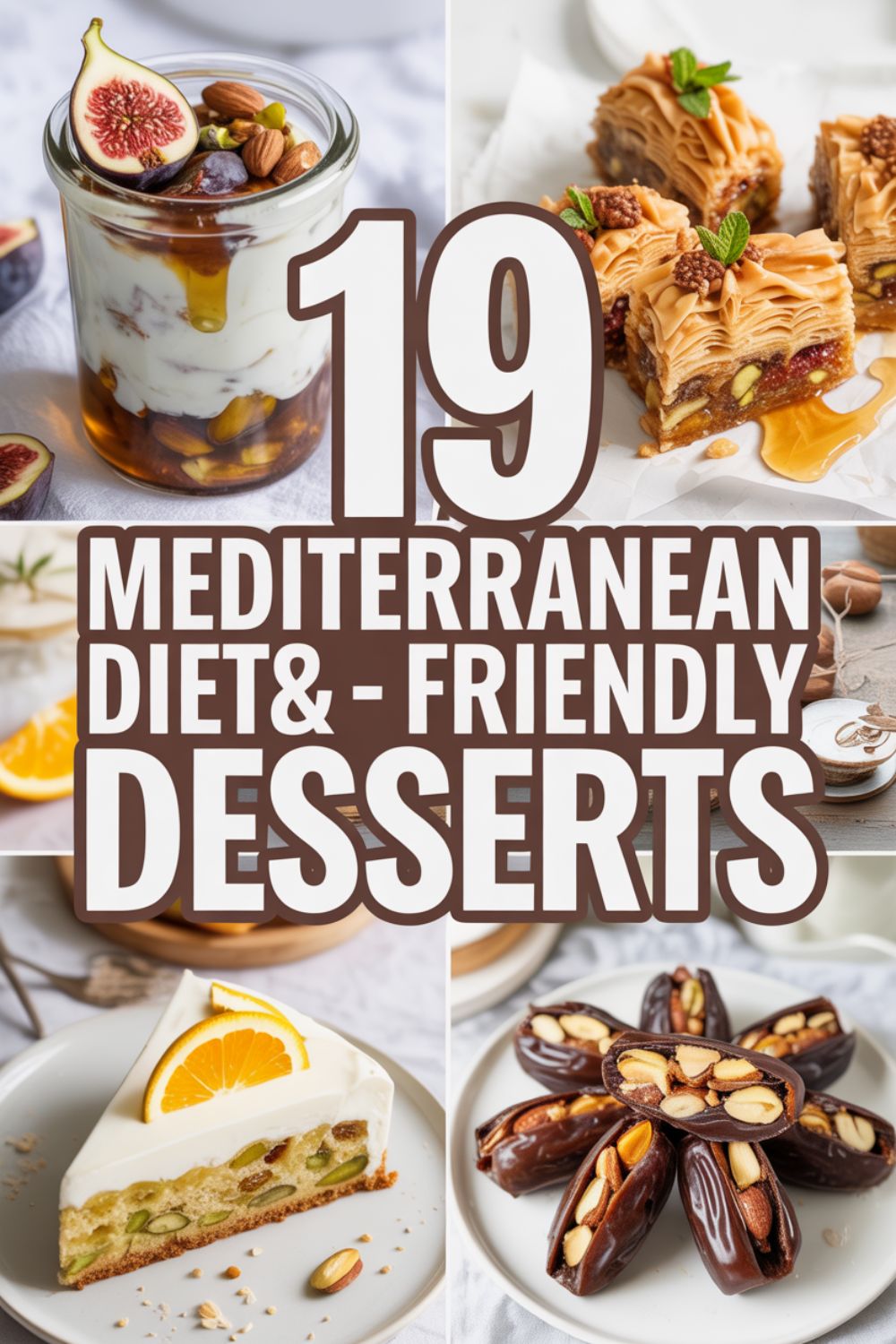
19 Mediterranean Diet-Friendly Desserts

19 Mediterranean Diet-Friendly Desserts That Are Actually Worth Making
Let me be straightforward with you: the phrase “Mediterranean diet dessert” used to make me roll my eyes so hard I nearly lost a contact lens. You picture a sad bowl of fruit, right? Maybe a single lonely fig on a white plate, like a still-life painting from someone who gave up on joy. But it turns out I was completely wrong, and I am very happy about that.
The Mediterranean way of eating is not about denial. It is about using good-quality ingredients — honey, nuts, fresh fruit, Greek yogurt, olive oil, dark chocolate — to build desserts that actually taste like desserts. According to Mayo Clinic’s overview of the Mediterranean diet, the eating pattern emphasizes whole, nutrient-dense foods and healthy fats, and that philosophy translates beautifully to the dessert world when you know what you are doing.
So below, I have gathered 19 Mediterranean diet-friendly desserts that run the full range from five-minute no-bake situations to weekend projects worth clearing your schedule for. Some of them will genuinely surprise you. All of them are worth your time.
These are the kitchen basics that make these recipes easy: creamy, rich and picture-perfect, the kind of treat your family asks for again and again.
- wide-mouth glass jars with lidsCheck today’s price →
- 9-inch springform panCheck today’s price →
- small heavy-bottomed saucepanCheck today’s price →
- Digital Kitchen ScaleCheck today’s price →
Amazon prices and deals change often, so it’s worth checking today’s price.
Why Mediterranean Desserts Deserve More Credit
Here is the thing about Mediterranean food culture that most people misunderstand: dessert was never the enemy. Across Greece, Italy, Turkey, Lebanon, and Morocco, people have been ending their meals with something sweet for thousands of years. The difference is that those sweets were built around figs, honey, walnuts, semolina, citrus zest, and yogurt — ingredients that happen to also be good for you. What a concept.
The healthline piece on Mediterranean diet meal planning points out that this pattern is rich in antioxidants, fiber, and healthy fats — all things that can show up in your dessert when you are choosing the right ingredients. Dates instead of refined sugar. Almond flour instead of white flour. Extra virgin olive oil instead of butter (yes, really — more on that later).
FYI, none of these desserts require a culinary degree, a special pantry imported from Athens, or six hours of free time. Most of them come together with ingredients you probably already have.
Keep a jar of good-quality raw honey and a bag of unsalted pistachios in your pantry at all times. Between the two of them, you can pull together a Mediterranean-inspired dessert in about three minutes flat.
The Honey, Nut, and Fruit Trio: Mediterranean Dessert Foundations
Before the recipes, it helps to understand the three building blocks that show up across almost every Mediterranean dessert tradition. Get comfortable with these three, and you can improvise endlessly.
Honey: The Sweetener That Does More Work
Raw honey is not just sweetness — it brings floral complexity, a slight natural acidity, and genuine depth to whatever you put it in. It also contains trace antioxidants that refined white sugar simply does not have. Greek thyme honey is exceptional if you can find it; a good wildflower honey works perfectly too. Worth having a quality raw Greek honey around rather than the squeeze-bear stuff from the back of your grocery shelf.
Nuts: Pistachios, Walnuts, Almonds — Pick Your Fighter
Each nut brings something different. Pistachios give you sweetness and a stunning green color. Walnuts bring bitterness and that characteristic earthy richness that pairs beautifully with honey and cinnamon. Almonds are the workhorse — versatile, mild, and great in both whole and flour form. For desserts, I find myself reaching for pistachios most often, but a mix of all three is never a bad call.
Fruit: Fresh, Dried, and Roasted
Mediterranean desserts lean heavily on figs, pomegranates, oranges, lemons, peaches, and grapes. Fresh fruit does a lot of work on its own, but roasting it completely transforms the game. When you roast a peach or a fig at a high temperature, the natural sugars caramelize into something that tastes almost like candy. No added sugar required. It is one of those cooking moves that feels like cheating in the best possible way.
The 19 Mediterranean Diet-Friendly Desserts
Greek Yogurt with Honey, Walnuts, and Cinnamon
This is the dessert that converted me. Full-fat Greek yogurt has a tangy creaminess that works beautifully as a dessert base, and when you layer on a proper drizzle of raw honey, a handful of crushed walnuts, and a pinch of good cinnamon, you have something genuinely satisfying. It takes about two minutes to put together and it feels indulgent in a way that is very hard to explain without just making you try it.
- Use full-fat Greek yogurt for the best texture
- Toast the walnuts first if you have an extra five minutes
- A pinch of flaky sea salt on top changes everything
Baked Figs with Ricotta and Pistachio
Fresh figs, halved and baked until they soften and caramelize, topped with a spoonful of creamy ricotta and a scatter of crushed pistachios. A drizzle of honey to finish. This is a dinner-party dessert that looks like you spent an hour on it but actually takes about fifteen minutes total, including prep. It is absolutely one of those recipes you keep in your back pocket for impressing people with minimal effort.
- Bake figs at 400°F for 10–12 minutes until just softened
- A tiny splash of balsamic in the baking dish adds complexity
- Ricotta can be swapped for labneh if you want to go full Mediterranean
Dark Chocolate and Almond Bark with Orange Zest
Melt good-quality dark chocolate (70% or higher), spread it thin on a lined baking sheet, scatter over toasted almonds, a generous amount of orange zest, and a pinch of flaky sea salt. Refrigerate until set, break into pieces. Done. Dark chocolate at this cocoa percentage is genuinely rich in antioxidants, and paired with nuts it becomes one of the more genuinely nutritious things you can eat as dessert without feeling like you are doing something responsible.
For this one, you really want a silicone baking mat — zero sticking, no parchment waste, and the bark releases in clean pieces every single time.
See next: 19 Weight-Loss-Friendly Party Sweets That Actually Taste Good →Orange Olive Oil Cake
This is where olive oil as a baking fat truly earns its reputation. Extra virgin olive oil makes cakes remarkably moist — more so than butter — and it adds a subtle savory depth that makes the citrus flavor pop. This particular version uses almond flour to keep it gluten-friendly and gives you a cake that stays tender for three days on the counter, which in my experience means you will eat it for breakfast twice and call it “a Mediterranean morning.”
- Use a fruity, mild-flavored extra virgin olive oil — not a peppery one
- Add a tablespoon of orange blossom water if you can find it
- Dust with powdered sugar and a bit of orange zest to serve
Chia Seed Pudding with Pomegranate and Honey
Chia pudding has had a serious glow-up in the Mediterranean diet world because chia seeds are an exceptional source of omega-3 fatty acids and soluble fiber — and they create a creamy, pudding-like texture when soaked in milk or coconut milk overnight. Top it with pomegranate arils (those jewel-red seeds), a drizzle of honey, and some crushed pistachios. The color contrast alone makes this look like something from a boutique hotel breakfast menu.
If you want to meal prep these in advance, wide-mouth glass jars with lids are the move — stack them in the fridge, grab one every night.
See next: 19 Weight-Loss-Friendly Brunch Ideas That Actually Taste Good →I made the chia pudding with pomegranate every Sunday night for a month and I genuinely looked forward to dessert more than I had in years. My husband, who thinks “healthy food” is an oxymoron, asked for seconds every single time.
— Maria T., reader from our communityLoukoumades — Greek Honey Donuts
Tiny, pillowy fried dough balls drizzled with warm honey, a sprinkle of cinnamon, and crushed walnuts. Loukoumades are ancient — literally ancient, served at Olympic Games in Greece thousands of years ago — and they are still one of the most joyful things you can eat. They are not an every-Tuesday dessert, but they are an absolutely perfect special-occasion treat that falls squarely within the Mediterranean tradition. Make them at least once. You will understand immediately.
- The batter needs to rest for at least 30 minutes before frying
- Fry in small batches to keep the oil temperature consistent
- Serve immediately — they lose their magic quickly once they sit
Roasted Peaches with Labneh and Thyme Honey
Few things in the dessert universe are simpler or more satisfying than a roasted stone fruit. Halve your peaches, place them cut-side down in a hot pan or oven, and let the sugars do their work. Serve them on a generous spoon of labneh (strained yogurt that is thicker and tangier than Greek yogurt), drizzled with thyme-infused honey and a few fresh thyme leaves. Summer in a bowl, and it happens to tick every Mediterranean diet box.
See next: 21 Budget-Friendly Healthy Desserts →Baklava (Lightened-Up Version)
Traditional baklava is a legitimate project, but the lightened version uses slightly less butter, a touch more nuts relative to layers, and a honey-based syrup instead of a straight sugar syrup. The result is something that still satisfies the deep baklava craving — crunchy, flaky, fragrant with cinnamon and clove — without the full sugary sledgehammer of the classic. IMO, this version actually lets the nut and honey flavors come through more clearly anyway.
- Keep your phyllo covered with a damp towel while you work — it dries out fast
- Pour the syrup while the baklava is hot and the syrup is cold (or vice versa)
- Let it sit for at least four hours before cutting — overnight is better
Tahini and Date Energy Balls
Tahini — sesame paste — is one of the most underused ingredients in Western dessert-making, which is a genuine shame because it brings a rich, slightly bitter nuttiness that pairs spectacularly with the caramel sweetness of Medjool dates. Blend them together, roll into balls, coat in sesame seeds or chopped pistachios, and refrigerate. These are technically a snack, but so is every piece of chocolate you have ever eaten standing in front of the fridge at 11pm, so let’s call it all dessert and move on.
See next: 19 Weight-Loss-Friendly Brunch Ideas That Actually Fill You Up →Semolina Cake (Basbousa) with Rose Water Syrup
Basbousa is a North African and Middle Eastern semolina cake soaked in a fragrant syrup — sometimes with rose water, sometimes orange blossom water, sometimes both. Semolina gives it a pleasantly grainy texture that is denser and more satisfying than regular cake, and the yogurt in the batter keeps it moist. The rose water syrup takes it somewhere completely unique. This one is worth getting a bottle of good rose water for — it keeps forever and shows up in a dozen other recipes.
See next: 27 Weight-Loss-Friendly Sweet Treats →For no-bake Mediterranean desserts, make a double batch on Sunday. They keep beautifully in the fridge all week, which means you actually eat something satisfying after dinner instead of hunting through cabinets for whatever is left of that holiday chocolate bar from November.
Almond Flour Lemon Cookies
These cookies use almond flour as their base, which means they are naturally gluten-free, higher in protein than traditional cookies, and have a wonderfully tender, almost fudgy texture. Lemon zest and a touch of vanilla keep them bright and fragrant. Sweetened with honey rather than refined sugar, they bake in about twelve minutes and cool in five — which is genuinely dangerous information to have. You will make a batch and eat four before they are even properly cooled. Not that I would know anything about that.
- Do not skip chilling the dough — it helps them hold their shape
- Press a single almond into the top of each cookie before baking for a beautiful finish
- Store in an airtight container — they stay perfectly soft for five days
Poached Pears in Spiced Red Wine
This is one of those desserts that makes your kitchen smell incredible. Whole pears gently simmered in a bath of red wine, cinnamon, star anise, orange peel, and a little honey until they turn deep ruby and become tender all the way through. Serve with a spoonful of mascarpone or Greek yogurt. This is genuinely dinner-party level without requiring any technical skill — you basically just watch it cook while enjoying a glass of the wine you did not use for poaching.
See next: 20 Keto-Friendly Desserts to Satisfy Sweet Cravings →Frozen Greek Yogurt Bark with Berries and Honey
Spread full-fat Greek yogurt on a lined baking sheet, swirl in some honey, scatter fresh mixed berries across the top, add a handful of granola or crushed almonds, and freeze until solid. Break into pieces and store in the freezer. This is one of those ideas that sounds almost too simple to be worth mentioning, and yet every person who makes it texts someone about it within twenty-four hours. The cold, creamy, tangy-sweet combination with the crunch of nuts is genuinely satisfying in the same way ice cream is, without the heavy sugar crash that follows.
See next: 25 Diet-Friendly Easter Dessert Table Ideas →Muhalabia — Lebanese Milk Pudding with Rose and Pistachio
Muhalabia is one of the oldest desserts in the Mediterranean and Middle Eastern tradition, and it is basically a delicate, just-set milk pudding flavored with rose water or orange blossom and topped with crushed pistachios. It is lighter than panna cotta, simpler than crème brûlée, and more interesting than either. Made with whole milk or a mix of milk and a small amount of cream, sweetened with just enough sugar to balance the rose water, it sets in about two hours in the fridge and costs almost nothing to make.
See next: 25 Diet-Friendly Garden Party Desserts That Actually Taste Amazing →Walnut and Honey Stuffed Medjool Dates
Split a Medjool date open, remove the pit, tuck in a walnut half, and drizzle with a tiny pour of dark chocolate or honey. That is genuinely the whole recipe. And yet these are so good that I have served them at actual dinner parties — on a nice plate with some fresh rosemary for styling — and had guests assume they were something more complicated. Dates are rich in natural sugars, fiber, and minerals, which makes this one of the more legitimately nutritious desserts on this list. Worth getting a quality box of large Medjool dates — the size and moisture level matters a lot here.
See next: 19 Weight-Loss-Friendly Party Sweets That Actually Taste Good →I started making the stuffed dates and the Greek yogurt bark every week. Three months in, I stopped craving the processed sweets I used to reach for every evening. I did not expect a handful of dates to do that, but here we are.
— James K., community memberLemon Ricotta Cake
This is arguably the most crowd-pleasing cake on this list. Whole-milk ricotta makes the crumb impossibly tender and moist, and a heavy hand with lemon zest plus a tablespoon of lemon juice keeps it bright and not too sweet. It is the kind of cake that people assume uses more butter and sugar than it actually does, which is always a satisfying thing to reveal after someone has had two pieces. Pairs beautifully with a spoonful of honey-drizzled yogurt on the side.
A reliable 9-inch springform pan makes this significantly easier to release cleanly — particularly important with the ricotta-heavy batter, which is tender enough to break if you are wrestling it out of a regular cake tin.
- Do not overbake — the center should still have a very slight wobble when you pull it out
- The flavor improves significantly the day after baking
Almond and Cardamom Cookies (Kourabiedes-Inspired)
Kourabiedes are traditional Greek shortbread cookies rolled in powdered sugar, and this version adapts them slightly — using almond flour for part of the base, adding a touch of cardamom alongside the usual vanilla, and pulling back on the butter just enough to keep them Mediterranean-diet-friendly without sacrificing the characteristic crumbly melt-in-your-mouth texture. They are dangerous. You have been warned.
See next: 19 Weight-Loss-Friendly Brunch Ideas That Actually Taste Good →Chocolate Olive Oil Mousse
Yes, olive oil in a chocolate mousse. I know. Bear with me. Extra virgin olive oil replaces the butter you would usually use, and the result is a mousse that is richer, silkier, and more interesting than the traditional version — with a very subtle, almost nutty undertone that makes the dark chocolate flavor deeper rather than competing with it. This is genuinely one of the more elegant desserts on this list, and it requires no baking, just good dark chocolate and a bit of patience while it chills.
- Use the best-quality dark chocolate you can find — 70% minimum
- A fruity, not peppery, olive oil works best here
- Chill for at least four hours; overnight is perfect
Saffron Panna Cotta with Orange and Pistachio
Panna cotta is Italian in origin and absolutely belongs in the Mediterranean dessert conversation. This version infuses warm cream with a small pinch of saffron — which turns the panna cotta a stunning pale gold and adds a subtle floral quality that plays beautifully against a simple orange syrup and crushed pistachios on top. Saffron is expensive per gram, but you use so little of it in a recipe that even a small jar goes a long way. Worth every penny for the color and aroma alone. To bloom the saffron properly, a small heavy-bottomed saucepan keeps the temperature controlled and prevents scorching.
See next: 21 Budget-Friendly Healthy Desserts →Swap refined sugar for raw honey in almost any Mediterranean dessert recipe at a 3:4 ratio (3/4 cup honey for every 1 cup of sugar). You will also reduce the liquid in the recipe by about 3 tablespoons per cup of honey to compensate.
The Ingredients That Make These Desserts Work
There are a handful of ingredients that appear across Mediterranean dessert traditions in country after country, and understanding what each one brings to the table helps you improvise, substitute, and make every recipe better.
Extra virgin olive oil works as a baking fat because its high oleic acid content keeps baked goods moist for longer than butter does. It also carries fat-soluble flavor compounds into the finished product in a way that gives Mediterranean cakes and cookies their distinctive richness. Do not use light olive oil here — it lacks the flavor compounds that make the difference.
Almond flour versus all-purpose flour is a comparison worth understanding. Almond flour is lower in carbohydrates, higher in protein and healthy fats, and produces a denser, moister crumb. It does not behave exactly like wheat flour, so you cannot do a straight swap in most recipes — but recipes designed around it produce results that are genuinely excellent and happen to be naturally gluten-free. You can explore more of those in this collection of desserts using alternative flours like almond and coconut.
Greek yogurt versus regular yogurt is another meaningful difference. Greek yogurt has been strained to remove most of the whey, which concentrates both the protein and the fat. Full-fat Greek yogurt has a richness and tanginess that works beautifully in both baked desserts and no-bake applications — and it pairs with sweetness in a way that regular yogurt simply does not.
Meal Prep Essentials Used in This List
A few things that genuinely make these Mediterranean desserts easier to put together and store:
Tools That Make Cooking Easier
These are the things I actually use, not a curated list of things that look nice in photos:
Frequently Asked Questions
Can you eat dessert on the Mediterranean diet?
Yes — the Mediterranean diet is not a zero-dessert eating pattern. It emphasizes fresh fruit, honey, nuts, and yogurt-based sweets over processed sugar and refined-flour pastries. Traditional Mediterranean cultures have always included dessert; the difference is in the ingredients and frequency. Occasion-based treats made with whole ingredients fit comfortably within the pattern.
Is honey better than sugar for Mediterranean diet desserts?
Raw honey is generally preferred in Mediterranean cooking because it contains trace antioxidants, enzymes, and minerals that refined white sugar lacks. It also has a more complex flavor, which means you often need less of it to achieve the same level of sweetness. That said, honey is still a sweetener and should be used in moderation — just not avoided entirely.
What are the best Mediterranean diet dessert ingredients to keep stocked?
The core pantry items that cover most of these recipes: raw honey, Medjool dates, tahini, almond flour, full-fat Greek yogurt, dark chocolate (70%+), pistachios, walnuts, lemons, and orange blossom or rose water. With these on hand, you can build the majority of recipes on this list without a special grocery trip. Good extra virgin olive oil is also essential, both for baking and for drizzling.
Are Mediterranean diet desserts suitable for people with diabetes?
Many of the recipes on this list use lower-glycemic sweeteners like honey and dates, higher-fiber almond flour, and ingredients like Greek yogurt that slow glucose absorption. However, individuals managing diabetes should consult with their healthcare provider or registered dietitian before making changes based on any specific dietary approach. For more diabetes-focused recipe ideas, check out these low-sugar dessert ideas for diabetes-friendly eating.
How do I make Mediterranean desserts lower in calories without ruining them?
The most effective moves: use Greek yogurt in place of cream or mascarpone, reduce honey by 20–25% and let quality ingredients carry more of the flavor, add citrus zest and spices to amplify sweetness perception without adding sugar, and focus on smaller portions of genuinely satisfying things rather than large amounts of watered-down alternatives. More ideas in this collection of low-calorie desserts that actually taste like treats.
The Bottom Line on Mediterranean Desserts
If you take one thing away from this list, make it this: eating well and eating sweetly are not opposing ideas. The Mediterranean diet has always understood that dessert is part of a joyful relationship with food — it just asks you to make it from real, honest ingredients.
Honey instead of processed sugar. Almond flour instead of refined white. Nuts and fruit instead of artificial flavors and hydrogenated oils. The result, as these 19 desserts prove, is something that tastes genuinely better — richer, more complex, more satisfying — not something that tastes like a punishment wearing a dessert costume.
Pick two or three from this list this week. Make them, eat them, share them if you feel like it. Chances are, you will not miss the other stuff as much as you thought you would.